
Acne & Acne Scars
What Are Acne and Acne Scars?
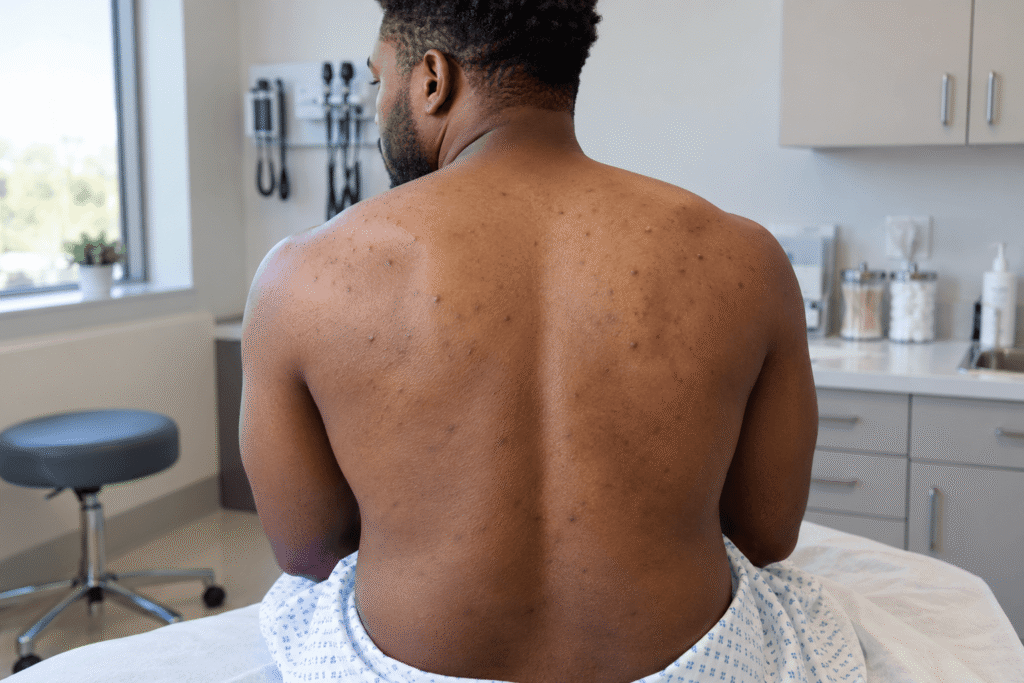
Acne vulgaris develops in the pilosebaceous unit, the hair follicle and its attached oil gland. When oil production increases, dead skin cells aren’t shed normally, and pores become blocked, creating an environment where acne-causing bacteria multiply and trigger inflammation. Acne is graded by severity, from mild (mostly whiteheads and blackheads) to moderate (numerous papules and pustules) to severe (painful nodules and cysts). Hormonal shifts, genetics, certain medications, and stress can all contribute, which is why acne can appear for the first time well into adulthood, not just adolescence.
Acne scars form when inflammation from a breakout damages the deeper layers of skin and disrupts normal collagen production. Depending on how that healing process unfolds, scars can be atrophic (depressed, from collagen loss) or hypertrophic and keloid (raised, from excess collagen). It’s worth distinguishing true scarring from post-inflammatory hyperpigmentation, the flat dark or red marks left after a pimple heals, which typically fades on its own over months, unlike true textural scarring.
How to Detect Acne and Acne Scars
- Blackheads and whiteheads (comedones), the mildest form
- Red, inflamed papules and pus-filled pustules
- Deeper, painful nodules or cysts that sit under the skin
- Oily skin, particularly across the forehead, nose, and chin
- Breakouts concentrated on the face, chest, back, or shoulders
- Rolling scars: broad, shallow depressions with sloping edges
- Boxcar scars: wider pits with sharper, more defined edges
- Ice pick scars: narrow, deep pits that extend further into the skin
- Hypertrophic or keloid scars: raised, thickened areas of scar tissue
- Persistent dark or red marks (PIH) that may accompany true scars but are a separate, usually temporary, issue
When Should You See a Doctor?
- OTC treatments haven't shown improvement after several weeks of consistent use
- Acne has lasted more than a few months or continues to get worse
- You're developing deep, painful bumps, nodules, or cysts
- Breakouts are leaving behind scars or dark spots
- Acne is affecting your self-esteem, mood, or mental health
- Scarring remains visible well after your acne has cleared
- You're not sure whether what you're seeing is true scarring or fading discoloration
- Scars are affecting your confidence or how you feel about your skin
What Happens If Acne and Scarring Are Left Untreated?
The longer an acne breakout goes untreated, the higher the risk of lasting consequences. Inflammation causes pores to swell and pore walls to break down, and when that damage reaches the deeper layers of skin, it leaves behind permanent scarring, whether pitted, depressed scars or darker patches of discoloration. Beyond the physical effects, untreated acne, especially persistent or cystic acne, is strongly linked to anxiety, reduced self-esteem, and depression.
Once scarring has formed, it doesn’t reliably improve on its own, and continued active acne in the same areas can add new scarring on top of existing damage. The practical cost of waiting on either problem is the same: the earlier acne is controlled and scarring is addressed, the better the long-term outcome and the fewer treatment sessions typically needed. Sun exposure can also worsen the visibility of any accompanying discoloration, so delaying treatment in a sun-intensive climate like Jupiter can make marks more stubborn to fade.

The Genesis Dermatology Process
- A consultation reviewing your skin type, breakout pattern, triggers, current products, and any existing scarring
- A personalized acne treatment plan, which may include topical retinoids, prescription-strength topicals, oral antibiotics, hormonal therapy, or isotretinoin for severe, cystic, or scarring acne, with close monitoring throughout
- In-office procedures like extractions, chemical peels, or light-based therapy for select patients
- Once acne is under control, a scar-specific plan: subcision to release fibrous bands under rolling and boxcar scars, microneedling to stimulate collagen, laser resurfacing, TCA cross for ice pick scars, filler injection, or cortisone injections and laser for hypertrophic and keloid scars
- A staged approach, since most patients need multiple scar-treatment sessions spaced weeks apart, along with follow-up visits to track acne control and adjust either plan as needed