
Skin Cancer Screening & Mole Checks

What Is A Skin Cancer Screening and Why Do Moles Matter?
A skin cancer screening, or full-body skin exam, is a visual and often dermatoscopic examination of your entire skin surface, from your scalp to the soles of your feet, performed by a dermatologist trained to recognize the subtle differences between a harmless spot and one that needs further evaluation.
Moles are a central part of that exam. Most adults have somewhere between 10 and 40 moles, and the overwhelming majority are completely harmless. But moles are also where melanoma most often develops, whether as a change within an existing mole or as a brand-new spot. Jupiter’s year-round sun exposure makes routine screening and mole awareness especially important for our patients. Many skin cancers are caught during a routine exam in a spot the patient hadn’t noticed or couldn’t easily see themselves, like the back or scalp.
How to Detect a Problem: Screening Exams and Self-Checks
- Asymmetry: one half of the mole doesn't match the other
- Border: edges are irregular, notched, blurred, or poorly defined
- Color: multiple shades of brown, black, tan, red, white, or blue within one spot
- Diameter: larger than 6 millimeters, roughly the size of a pencil eraser, though melanoma can be smaller
- Evolving: any change in size, shape, color, elevation, or new symptoms like itching or bleeding, often the most important warning sign
- Also watch for the "ugly duckling" sign: a mole that looks noticeably different from your other moles, even if it doesn't check every ABCDE box
- Beyond moles, your dermatologist is also checking for new or changing bumps and patches, sores that haven't healed, and rough, scaly areas anywhere on the body, using a handheld dermatoscope to look beneath the skin's surface for patterns invisible to the naked eye
When Should You See a Doctor?
- Most adults benefit from an annual full-body skin exam, starting in early adulthood
- Every six months if you have a personal history of skin cancer, a strong family history, many moles, or significant past sun exposure or sunburns
- Sooner than your next scheduled visit if you notice a mole matching the ABCDE criteria, a new mole appearing after age 30, or any spot that itches, bleeds, or won't heal
- Monthly self-exams at home are recommended between professional screenings to catch changes early
What Happens If You Skip Screening or Ignore a Changing Mole?
Skin cancers caught late are harder to treat, more likely to require extensive surgery or reconstruction, and, in the case of melanoma, more likely to have already spread by the time they’re found. A skin cancer that would have been a quick in-office procedure if caught during a routine screening can become a much longer, more complicated course of treatment when discovered late.
This is especially true for moles. If a changing mole turns out to be melanoma, time is the single biggest factor in how serious it becomes. Melanoma caught while still confined to the outer layers of skin is highly treatable with a straightforward excision. The longer it goes unchecked, the deeper it can grow, and depth is directly linked to the risk of the cancer spreading to lymph nodes and other organs. Because early skin cancer often doesn’t hurt or cause obvious symptoms, regular screening and prompt evaluation of changing moles are what close that gap.
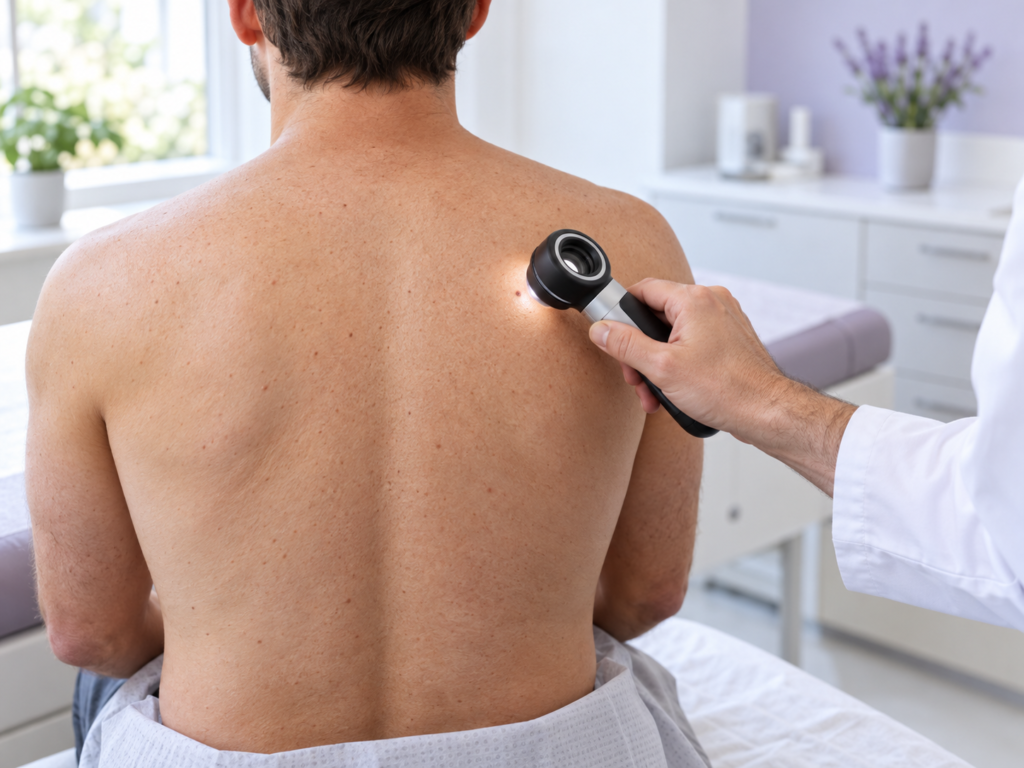
The Genesis Dermatology Process
- A private, respectful, head-to-toe-skin exam performed by a board-certified dermatologist
- Dermoscopic evaluation of any moles or spots that warrant a closer look, along with a comparison to your other moles
- Photography or mole mapping for patients with many moles or a higher-risk history, to track changes over time
- An in-office biopsy on the spot if something needs further evaluation, with results typically available within about a week
- A personalized recommendation for how often you should be screened going forward, based on your skin type, mole count, and risk factors